
Deionised water for solar panel cleaning, and the TDS reading that matters
Deionised water for solar panel cleaning must read below about 10 ppm on a TDS meter, at which point it dries on glass without leaving mineral spots and needs no drying pass. South African municipal water typically reads 100 to 400 ppm, and borehole water often exceeds 1,000 ppm.
What a TDS meter measures
Total dissolved solids is the mass of dissolved minerals carried in the water, reported in parts per million. A TDS meter reads electrical conductivity and converts it to that figure. The number predicts exactly one thing that matters at an array: what stays behind on the glass when the water evaporates.
| Water source | Typical TDS | Result on solar glass |
|---|---|---|
| Deionised water | 0 to 10 ppm | Dries clear, no drying pass needed |
| Rainwater from a clean tank | 10 to 60 ppm | Light spotting on dark glass |
| Coastal municipal supply | 60 to 200 ppm | Visible spots, drying pass required |
| Inland municipal supply | 150 to 400 ppm | Clear spotting, drying pass required |
| Borehole water | 400 to 2,000 ppm | White mineral deposit after one clean |
Reading the supply before buying filtration is the single cheapest step in the whole process. A TDS meter costs a fraction of a DI vessel and tells the operator which vessel size the site needs.
Deionised, distilled and reverse osmosis compared
Three processes reach low TDS by different routes, and the running costs differ by an order of magnitude at array scale.
| Process | How it works | TDS achieved | What drives running cost |
|---|---|---|---|
| Deionisation | Ion-exchange resin swaps dissolved minerals for hydrogen and hydroxide | 0 to 10 ppm | Resin consumption, which scales with input TDS |
| Reverse osmosis | Pressure forces water through a semi-permeable membrane | 10 to 40 ppm | Membrane life and reject water volume |
| Distillation | Water is boiled and the vapour condensed | 0 to 5 ppm | Energy, which rules it out at array volumes |
Distilled water and deionised water reach comparable purity. The difference is throughput: distillation produces litres per hour at high energy cost, while a DI vessel produces hundreds of litres per hour with no power at all. That is why panel cleaning uses deionisation and laboratories use distillation.
What consumes DI resin, and how fast
Resin has a fixed ion-exchange capacity. Every mineral it removes uses part of that capacity, so resin life is set by the input water rather than by time. Water at 300 ppm exhausts a vessel roughly three times faster than water at 100 ppm for the same litres produced.
Reverse osmosis fitted ahead of the DI vessel is the standard answer on hard water. The membrane strips most of the mineral load, the resin polishes what remains, and resin life extends several-fold. On soft municipal water the pre-filter earns nothing and adds complexity.
Why spots form, and why they matter on a panel
A drying droplet shrinks toward its centre and deposits its entire mineral load in a ring. That ring scatters incoming light rather than transmitting it. On a window the effect is cosmetic. On a photovoltaic panel the scattered fraction never reaches a cell, so spotting is a direct output loss on a surface that was just cleaned.
Spots build cumulatively. Each tap-water clean adds another mineral layer, and the deposit eventually needs an acid descale rather than a wash. Cleaning method is set out in how to clean solar panels.
Water volume at scale
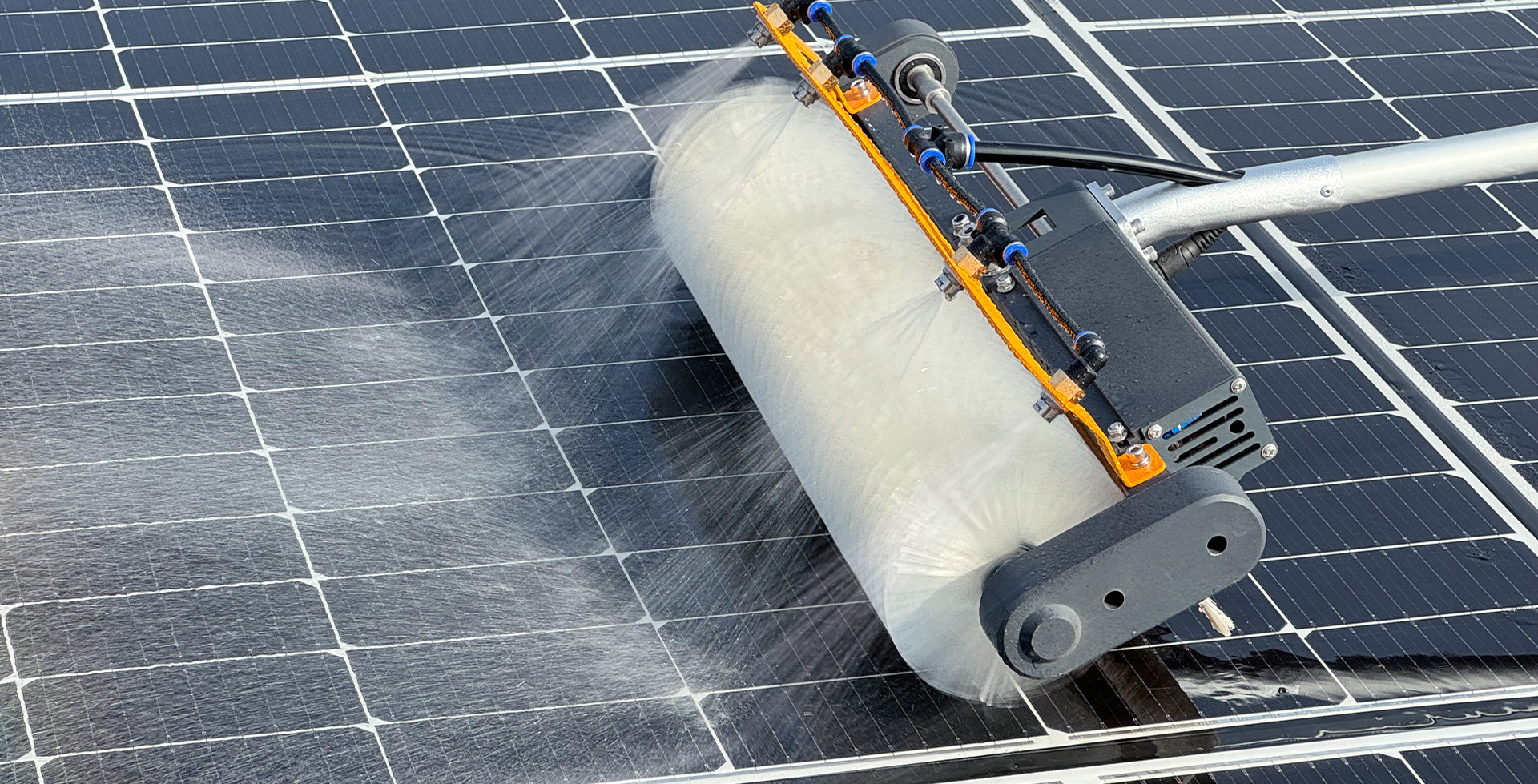
Water purity matters most where water volume is largest. A brush-fed system uses well under 2 litres per panel because the brush does the mechanical work and the water only carries the loosened dirt away. Hosing a panel clean uses several times that. At plant scale the difference sets the size of the bowser and the number of trips, which is covered in solar farm panel cleaning.
Questions
Is deionised water necessary to clean solar panels?
No, and it saves a drying pass on every panel. Tap water cleans a panel equally well provided the glass is squeegeed dry before it evaporates, which roughly doubles the labour.
Is deionised water the same as distilled water?
No. Both reach very low TDS, by different processes. Deionisation exchanges ions across a resin bed at high throughput and no power, and distillation boils and condenses the water at high energy cost and low throughput.
What TDS reading is low enough for spot-free cleaning?
Below about 10 ppm. Between 10 and 50 ppm light spotting shows on dark glass, and above 50 ppm a drying pass becomes necessary.
Can rainwater be used to clean solar panels?
Yes when the tank is clean, because rainwater typically reads between 10 and 60 ppm. Tank sediment and roof runoff raise that figure, so the reading needs checking rather than assuming.