
How to clean solar panels safely from the ground
Clean solar panels with a soft brush and low-mineral water while the glass sits below 30 °C, which in South Africa means before 09:00 or after 17:00. Wet the panel first, brush along the frame, rinse from the top down, and keep any pressure washer below 40 bar.
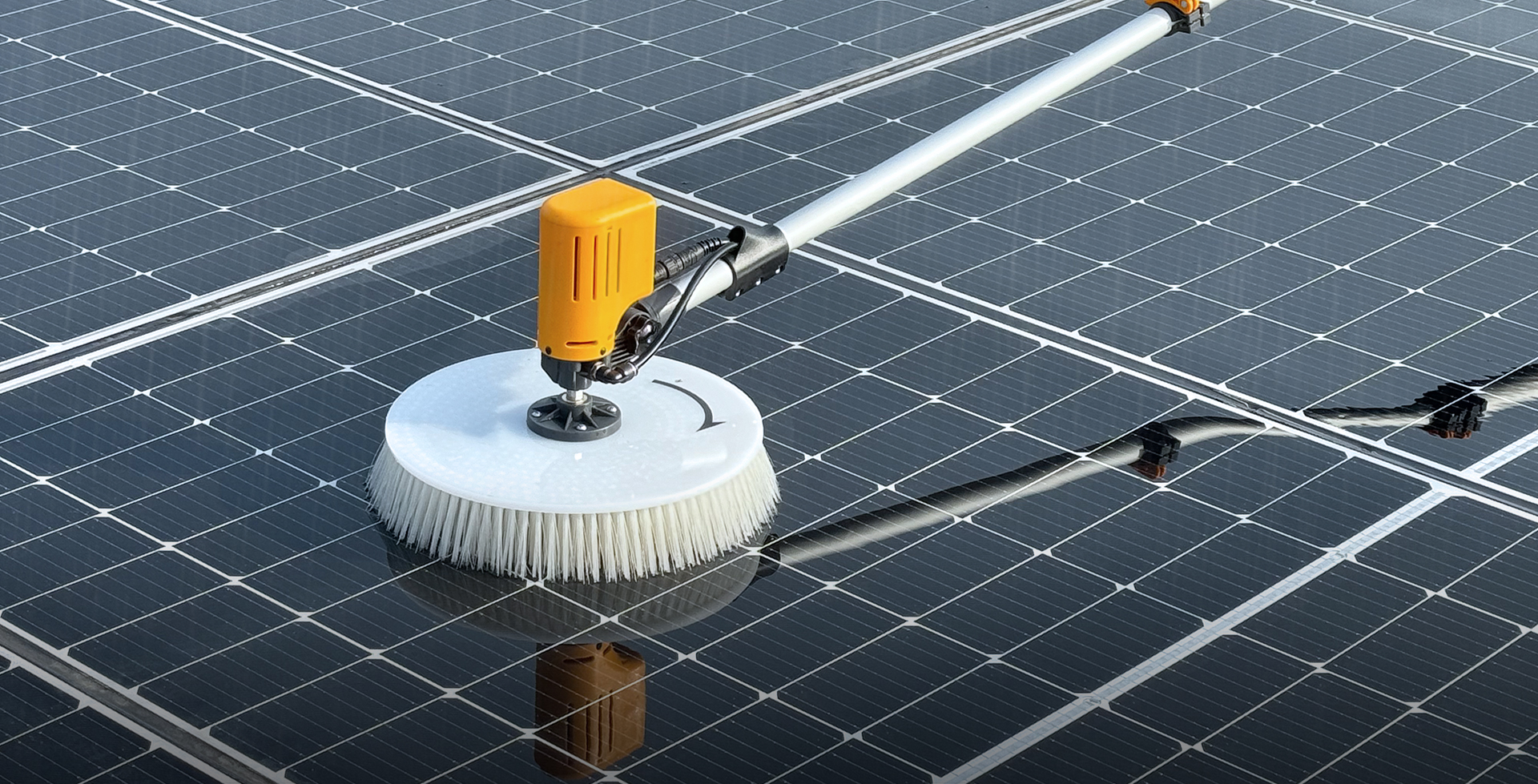
The six-step method
- Check the glass temperature. Cold water on glass above roughly 40 °C risks thermal shock and micro-cracking. Early morning is the safest window in every South African province.
- Wet the whole panel before touching it. Dry brushing drags grit across the anti-reflective coating, which produces the fine scratch pattern owners mistake for manufacturing haze.
- Brush along the long axis of the frame. Water and loosened dirt run off the low edge instead of collecting against the frame lip.
- Work one panel at a time. A panel that dries mid-clean leaves a tide line that needs a second pass.
- Rinse from the top edge down. Gravity does the work, and the final rinse water is the water that dries on the glass.
- Leave the panel to air dry. Low-mineral water dries without spots, so no drying pass is needed. That is the whole reason for using deionised water.
Steps two, five and six decide the result. Steps one, three and four decide whether the panel survives the next ten years without visible wear.
Water: the variable that decides the finish
Water quality determines whether the glass dries clear or dries spotted. Municipal tap water in South Africa typically carries 100 to 400 parts per million of dissolved solids, and every one of those minerals stays on the glass when the water evaporates. Borehole water frequently exceeds 1,000 ppm and leaves a visible white deposit after a single clean.
Two routes solve the problem. Deionised water dries spot-free and needs no drying pass, covered in deionised water for solar panel cleaning. Tap water works when every panel is squeegeed dry immediately, which roughly doubles the labour per panel.
Timing: why panel temperature sets the hour
A panel in full South African sun reaches 55 to 70 °C on the glass surface, well above ambient air temperature. Water at 15 °C applied to glass at 65 °C creates a thermal gradient across the laminate. Cleaning before 09:00 keeps the glass near ambient, and cleaning after 17:00 works equally well on a west-facing array.
Overcast days remove the constraint entirely, which makes winter cleaning simpler than summer cleaning across most of the country.
What damages a solar panel during cleaning
| Action | What it damages | Result |
|---|---|---|
| Dry brushing | Anti-reflective coating | Fine scratch haze, permanent |
| Pressure above 40 bar | Frame seals, junction box | Moisture ingress, delamination |
| Abrasive pad or scouring sponge | Glass surface | Light scatter, reduced output |
| Household detergent | Coating and seals | Residue film that attracts dust faster |
| Cold water on hot glass | Cell laminate | Micro-cracks, invisible until output drops |
| Standing on the panel | Cells beneath the glass | Cracked cells, warranty refused |
Five of the six are avoided by equipment choice alone. Standing on a panel is avoided by pole length, which is the next section.
Reaching the array from the ground
Ground-level cleaning removes the fall risk and the panel-loading risk in one decision. Pole length is set by the height of the highest panel plus the horizontal distance the operator stands back from the wall.
| Highest panel | Typical building | Pole length |
|---|---|---|
| 3 to 4 m | Single storey, low pitch | 5.4 m |
| 4 to 6 m | Single storey, steep pitch or raised | 8 m |
| 6 to 9 m | Double storey | 12 m |
| Ground mounted | Carport or ground array | 3 m or handheld |
Carbon fibre holds its rigidity at 8 m and above, where an aluminium pole of the same length flexes enough to make brush contact inconsistent. That trade-off is the reason the 12 m systems in the solar cleaning equipment range use carbon fibre.
How often the method repeats
Method and interval are separate decisions. A correct method applied once a year still leaves an array underperforming for ten months of it. Interval depends on what settles on the glass locally, set out in how often to clean solar panels, and on whether birds have taken up residence under the array, covered in solar panel bird proofing.
Questions
Will a soft brush scratch panel glass?
No, provided the glass is wet before the bristles touch it. Scratching comes from grit dragged across the surface, not from the bristles. Soft nylon and microfibre heads are specified for photovoltaic glass because they release grit into the water film instead of holding it against the coating.
Can a pressure washer clean solar panels?
Yes, below 40 bar and with a wide fan nozzle held back from the frame. Above that pressure the water finds the frame seal and the junction box, and moisture inside the laminate is not recoverable.
Can borehole water be used to clean solar panels?
No, not without treatment. Borehole water in South Africa frequently exceeds 1,000 ppm dissolved solids and leaves a white mineral deposit harder to remove than the dust it replaced.
Should solar panels be dried after cleaning?
Yes when tap water is used, and no when deionised water is used. Water below about 10 ppm evaporates without leaving a mineral residue, which removes the drying pass entirely.